

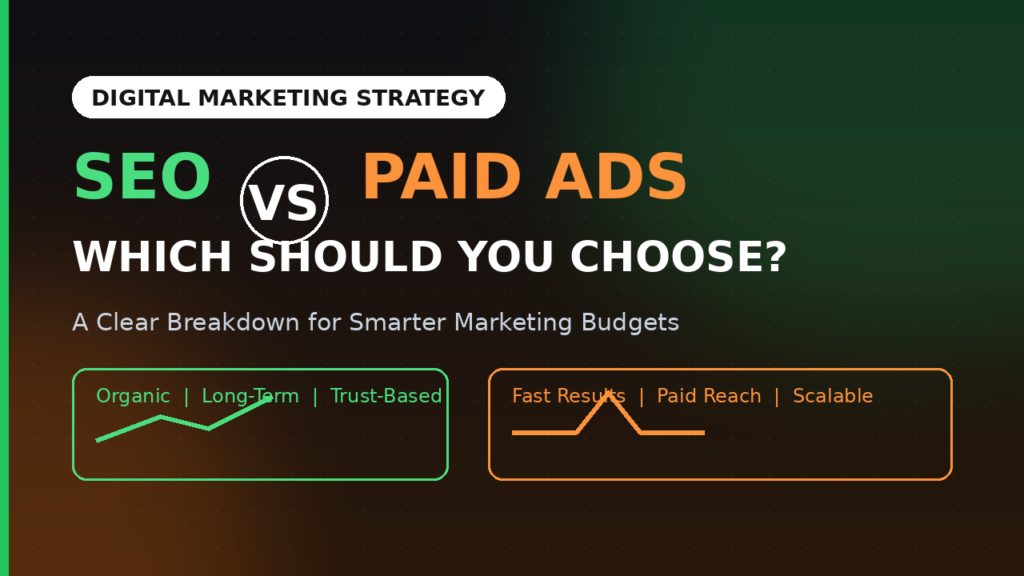
SEO VS PAID ADS
SEO vs Paid Ads: Which Should You Choose? SEO (Search Engine Optimization) and Paid Ads (Pay-Per-Click advertising) are two of the most important digital marketing strategies. Both can help a business increase website traffic, generate leads, attract customers, and improve sales. However, they work in very different ways. SEO focuses on improving a website so that it appears naturally in search engine results. Paid advertising involves paying platforms such as Google or social media networks to display advertisements to a specific audience. The question is not simply “Which is better: SEO or Paid Ads?” The better question is “Which strategy is right for my business, goals, budget, and timeline?” 1. Introduction to SEO SEO stands for Search Engine Optimization. It is the process of improving a website and its content so that search engines can understand it and potentially rank it higher in unpaid or organic search results. When someone searches for something on Google, they usually see several types of results. Some are advertisements, while others are organic results. For example, imagine that someone searches: “Best digital marketing course near me.” A business can try to appear in the organic search results by using SEO. Instead of paying Google every time someone clicks the result, the business works on its website, content, technical performance, and authority. SEO generally includes several areas: The main objective is to make a website more useful and trustworthy for both search engines and users. 2. What Are Paid Ads? Paid advertising is a digital marketing strategy where businesses pay an advertising platform to show their advertisements to potential customers. One of the most common forms is PPC, or Pay-Per-Click advertising. For example, a company selling shoes could create a Google advertisement for the keyword: “buy running shoes online.” When people search for that keyword, the advertisement may appear at the top of the search results. Depending on the advertising model, the business may pay when someone clicks the advertisement. Paid advertising is available across many platforms, including: Paid ads can be used for: 3. SEO vs Paid Ads: Basic Difference The biggest difference is simple: SEO earns visibility, while paid advertising buys visibility. With SEO, you invest time and resources into improving your website and content. With paid ads, you pay an advertising platform to place your message in front of a selected audience. For example: SEO Paid Ads Organic traffic Paid traffic Long-term strategy Short-term/immediate strategy Usually slower to produce results Can produce results quickly No direct payment for every organic click Often charged per click or impression Requires content and optimization Requires advertising budget Results can continue after work is completed Traffic usually stops when campaigns stop Builds long-term search visibility Provides immediate visibility Strong for sustainable growth Strong for fast testing and campaigns Neither strategy is automatically better. The right choice depends on your specific marketing objective. 4. How SEO Works Search engines use automated systems to discover, understand, organize, and rank webpages. A business therefore needs to help search engines understand: SEO can be divided into several major categories. On-Page SEO On-page SEO involves optimizing elements directly on a webpage. Examples include: For example, instead of creating a page titled: “Services” a digital marketing agency might create a more descriptive page targeting a relevant topic such as: “Digital Marketing Services for Small Businesses.” The page should then provide genuinely useful information related to that topic. Technical SEO Technical SEO focuses on the technical aspects of a website. Important areas include: A technically strong website makes it easier for search engines to crawl and understand its pages. Content SEO Content is a major part of modern SEO. Businesses can create: Good SEO content should not simply repeat keywords. It should answer the questions users actually have. For example, a digital marketing website might publish articles such as: “What is SEO?” “SEO vs Paid Ads: Which Is Better?” “How to Create a Digital Marketing Strategy?” “How Does Google Ads Work?” These pages can attract people searching for information related to digital marketing. 5. Advantages of SEO 5.1 Long-Term Benefits One of SEO’s biggest advantages is its long-term potential. If a website creates a useful page that ranks well for a valuable search query, it can potentially generate visitors for months or even years. This does not mean rankings are permanent. Search results can change because of competition, algorithm updates, changing user behavior, and changes to the website itself. However, successful SEO can create an asset that continues generating traffic. 5.2 Lower Direct Traffic Costs With organic search, businesses do not normally pay a search engine for each organic click. This can make SEO attractive for businesses that want to reduce their dependence on ongoing advertising spend. However, SEO is not free. Businesses may spend money on: Therefore, SEO should be viewed as an investment rather than completely free marketing. 5.3 Builds Authority High-quality content can help a business establish expertise in its industry. For example, imagine a company that sells digital marketing services. It publishes detailed resources about: Over time, the website can become a useful resource for people researching digital marketing. This can support brand credibility and customer trust. 5.4 Supports Different Stages of the Customer Journey SEO can reach people at different stages of the buying journey. For example: Awareness:“What is SEO?” Research:“SEO vs paid ads” Consideration:“Best SEO agency for small business” Purchase:“SEO agency pricing” A strong SEO strategy can create content for each stage. 6. Disadvantages of SEO SEO also has disadvantages. 6.1 It Takes Time SEO usually does not produce significant results immediately. A new website may need time to: This makes SEO less suitable when a business needs customers immediately. 6.2 Competition Can Be Strong Some keywords are extremely competitive. For example: “digital marketing” “insurance” “online shopping” “best laptops” Thousands of websites may compete for related searches. Ranking for highly competitive keywords can require significant resources. 6.3 Algorithm Changes Search engines continually improve their systems. A website that performs well today may not necessarily maintain exactly